
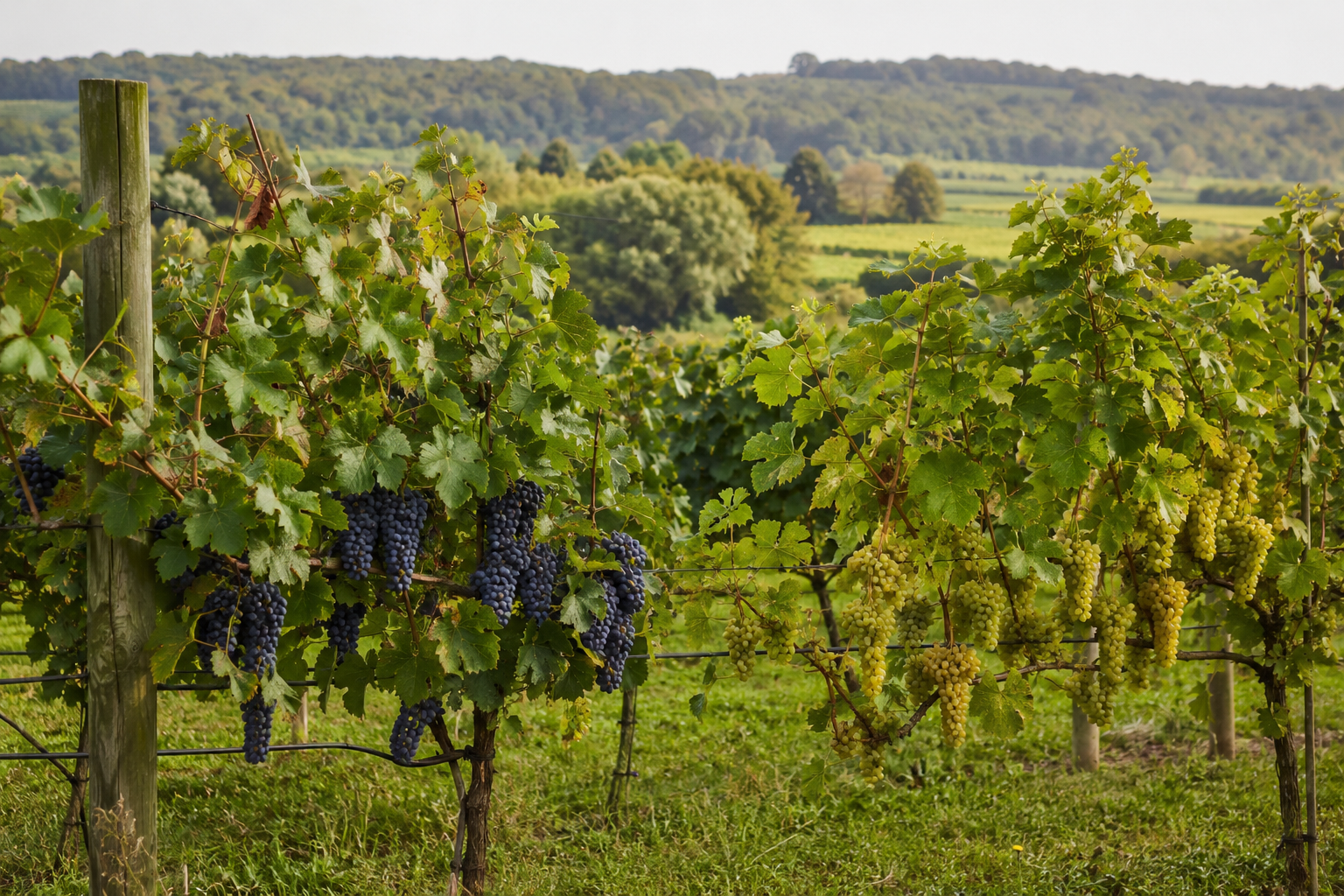
Ask someone to name the grape associated with Napa Valley and Cabernet Sauvignon will probably come to mind. Burgundy is identified with Pinot Noir and Chardonnay. Marlborough built an international reputation around Sauvignon Blanc.
What grape belongs in that conversation for the Brandywine Valley?
The honest answer is that we do not know yet. The region grows a broad mix of European grape varieties and hybrids, but no single grape has clearly emerged as its defining variety.
That uncertainty is not a weakness. It is an invitation to explore.
What Is a Signature Grape?
A signature grape is more than a variety commonly planted in a region. It should have a meaningful connection to the place and produce wines that consumers can recognize, enjoy and seek out.
A strong candidate should ideally:
- Ripen successfully in the local climate
- Perform across more than one favorable vintage
- Tolerate the region’s disease and weather pressures
- Produce distinctive, high-quality wine
- Work well on suitable sites without requiring unreasonable intervention
- Offer producers a compelling story
- Inspire interest from local wine drinkers
- Provide enough commercial value to justify planting and maintaining it
No grape will satisfy every criterion perfectly. There may also be different answers for white, red, rosé and sparkling wine.
The search should therefore focus on sustained performance, not one memorable bottle.
The Case for Familiar Vinifera Grapes
Vitis vinifera is the European grape species that includes most of the varieties associated with the world’s established wine regions. Chardonnay, Cabernet Franc, Cabernet Sauvignon, Pinot Noir, Riesling and Sauvignon Blanc all belong to this species.
Southeastern Pennsylvania contains much of the state’s vinifera production, according to Penn State Extension. This suggests that the area’s relatively long and warm growing season offers possibilities for internationally familiar varieties.
Vinifera grapes bring several advantages:
- Consumers already recognize their names
- Their typical characteristics are well documented
- They allow comparison with wines from established regions
- Restaurants and retailers may find them easier to explain and sell
- Winemakers have access to extensive technical experience from around the world
They also face challenges in the Brandywine environment. Many vinifera varieties are comparatively susceptible to fungal disease, and some require a long, favorable season to reach full maturity. Humidity, rainfall and late-season rot can make their performance less consistent.
A familiar name may help sell the first bottle, but regional success ultimately depends on what is inside it.
Cabernet Franc: A Serious Red Candidate
Cabernet Franc deserves close attention.
It generally ripens earlier than Cabernet Sauvignon, which can be valuable where autumn rain and falling temperatures create risk. It can produce red wines with fresh acidity, red and black fruit, floral notes, herbal complexity and moderate tannins.
The potential difficulty is achieving full flavor maturity without excessive green or vegetal character. Site selection, crop level, canopy management and harvest timing can all affect the result.
Questions to investigate include:
- Does Cabernet Franc ripen consistently across Brandywine vintages?
- Can it achieve ripe fruit and tannins while retaining freshness?
- Which vineyard exposures produce the most balanced wines?
- Are the best results varietal wines or blends?
- Does it develop a recognizable local expression?
Cabernet Franc has credibility in other eastern North American wine regions, but that does not automatically make it Brandywine’s signature red. The evidence must come from local vineyards and wines.
Chardonnay: Versatile but Not Automatically Distinctive
Chardonnay is adaptable in both the vineyard and winery. It can produce still or sparkling wine and can be shaped through choices involving oak, malolactic conversion, lees contact and fermentation vessels.
That versatility gives local producers many options. It can also make regional identity harder to identify because winemaking decisions may dominate the final style.
For Brandywine Chardonnay, I will be looking for:
- Reliable ripening with retained acidity
- Healthy fruit in humid conditions
- Balance rather than excessive alcohol
- Clear distinctions between sites and vintages
- Sparkling-wine potential
- Winemaking that complements rather than overwhelms the fruit
Chardonnay may prove important to the region even if it never becomes uniquely associated with it.
Other Vinifera Possibilities
Several other familiar grapes warrant investigation.
Sauvignon Blanc
Sauvignon Blanc’s naturally high acidity and aromatic character could be useful in a warm, humid region. Canopy management and harvest timing will influence whether the wines emphasize freshness and fruit or show excessive herbaceousness.
Pinot Noir
Pinot Noir can produce compelling still and sparkling wines, but its thin skins, tightly packed bunches and sensitivity to rot can make it demanding in wet conditions. Success may depend on carefully selected sites, clones, crop levels and vintages.
Riesling
Riesling retains acidity and can produce styles ranging from dry to sweet. Its late-season hanging time and susceptibility to bunch rot may complicate production, although suitable sites and well-timed harvests could reveal potential.
Petit Verdot and Cabernet Sauvignon
These later-ripening red varieties may perform in the region’s warmest sites and strongest vintages. Their reliability across more difficult years remains an important question. They may also be valuable as blending components rather than stand-alone regional flagships.
The point is not to create an exhaustive list. It is to understand that suitability must be demonstrated locally, not inferred from reputation elsewhere.
The Case for Hybrid Grapes
Hybrid grapes are created by crossing grape species to combine useful characteristics. Many incorporate European wine-grape ancestry with American species that can contribute cold tolerance, disease resistance or other forms of adaptation.
They are sometimes treated as secondary to vinifera, but that assumption deserves examination.
In a warm, humid growing environment, disease resistance and reliable ripening can have significant value. Reduced disease susceptibility may lower crop losses and, depending on the grape and vineyard, could reduce some chemical inputs.
Hybrids also offer the possibility of wines that are less easily compared with familiar international styles. That can be a marketing challenge, but it may also give the region a more original identity.
A hybrid should not be celebrated simply because it is easier to grow. The wine must still be balanced, expressive and enjoyable.
Chambourcin: A Distinctive Red Possibility
Chambourcin is a French-American hybrid grown in Pennsylvania and elsewhere in the eastern United States. Cornell describes it as a late-ripening grape capable of producing highly rated red wine when the fruit reaches full maturity.
Its color, fruit character and disease tolerance make it an interesting candidate. It can produce dry red wine, rosé and blends.
Its late ripening introduces an important tension. Disease resistance may help it tolerate humid conditions, but it still needs enough warmth and time to mature. Crop level and site selection are therefore critical.
The questions for Brandywine Chambourcin include:
- Can it ripen fully and consistently?
- Which styles best suit the fruit?
- Does it perform better as a varietal wine or in blends?
- Can producers manage its acidity and structure without losing character?
- Does it offer a taste that consumers will identify with the region?
Chambourcin may have greater regional distinctiveness than a globally familiar grape, but it must earn that position through the quality of the wine.
Vidal Blanc: Reliability and Range
Vidal Blanc is another hybrid with an established presence in eastern North America. It can retain acidity, accumulate sugar and support several wine styles, including dry, off-dry, sweet and dessert wines.
Penn State research has also found useful resistance to black rot in Vidal compared with several other varieties under the conditions studied. That does not make it immune to disease or eliminate the need for vineyard management, but it illustrates the potential value of adapted varieties in a humid region.
Questions for local Vidal include:
- Which level of sweetness best balances its acidity?
- Can it produce compelling dry wine?
- Does it offer enough aromatic and textural character?
- How consistent is its quality across vintages?
- Could it contribute to sparkling wine or blends?
A grape capable of several styles can be valuable, although that flexibility may make it harder to establish a single recognizable regional expression.
Other Hybrids Worth Watching
Other varieties may also deserve attention, including Vignoles, Seyval Blanc, Chardonel, Traminette, Cayuga White, Noiret and newer disease-resistant grapes.
Each brings a different combination of ripening time, acidity, aromatics, disease susceptibility and wine style. Some may be better suited to a specific purpose than to serving as an all-encompassing regional signature.
For example, one grape might excel in sparkling wine, another in aromatic white wine and another in rosé. The region’s strongest identity may eventually rest on a group of complementary varieties.
Does Brandywine Need One Signature Grape?
Perhaps not.
A signature grape can help a developing region communicate clearly. It gives visitors something to look for and provides producers with a shared point of reference.
However, selecting one too early could encourage plantings based on marketing enthusiasm rather than long-term evidence. It could also overlook differences among sites or marginalize wines that perform well but do not fit the chosen identity.
Brandywine’s future may involve:
- One leading red and one leading white grape
- A recognizable strength in sparkling wine
- A combination of vinifera and hybrid varieties
- Blends adapted to vintage variation
- Several grapes matched to distinct vineyard settings
- A broader identity based on freshness, balance and regional character
The answer should emerge from repeated success in the vineyard and the glass.
How I Will Evaluate the Candidates
Brandywine in the Glass will use a consistent framework when comparing grapes and wines.
Vineyard performance
- Ripening date and consistency
- Disease pressure and fruit condition
- Yield and crop reliability
- Sensitivity to rainfall, humidity, frost and winter cold
- Suitability for different slopes, soils and exposures
Wine quality and character
- Balance of fruit, acidity, alcohol, tannin and sweetness
- Aromatic and flavor intensity
- Complexity and length
- Vintage consistency
- Ability to express differences among sites
- Development with bottle age
Regional and commercial potential
- Distinctiveness
- Consumer appeal
- Versatility
- Availability from multiple producers
- Ability to command sustainable pricing
- Strength of connection to the Brandywine Valley
This framework will not turn wine into a mathematical exercise. It will help ensure that enthusiasm for one bottle does not become an unsupported conclusion about an entire region.
The Most Interesting Answer May Surprise Us
The Brandywine Valley’s signature grape may already be growing here. It may be familiar, overlooked or used primarily in blends. It may be a hybrid that many wine drinkers have never tasted. The region may even discover that its strength lies in a style of wine rather than one variety.
For now, I will resist choosing a winner.
The next step is to taste across wineries, vintages and styles, learn where the grapes were grown and listen to the experiences of the people farming them. I will share those findings so that others can discover the wines, understand the differences and decide what they most enjoy.
Finding what truly belongs in the Brandywine glass should be an evidence-based search, but it should also be fun.
Leave a Reply