
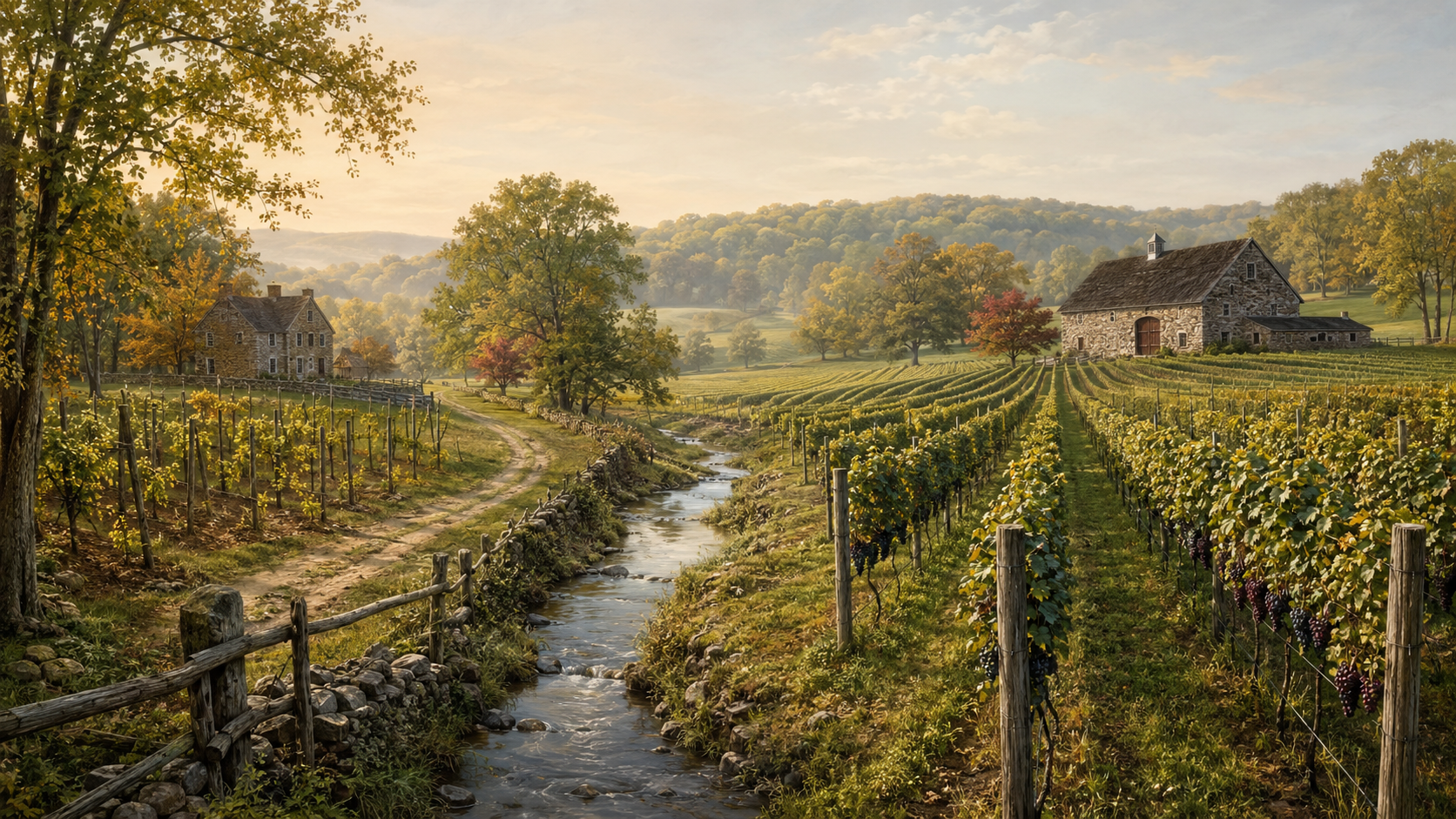
The Brandywine Valley is better known for its rolling farmland, Revolutionary War history, country estates and the du Pont family than for wine. Yet grape growing has been part of the broader region’s agricultural story since the colonial period.
This is not the history of an uninterrupted wine industry. Vineyards appeared, disappeared and returned in different forms. Early colonists experimented with native and European vines. Eighteenth-century entrepreneurs attempted commercial production. Prohibition and restrictive laws interrupted the industry, while modern growers gradually rediscovered the potential of the landscape.
The present Brandywine Valley wine community, extending across southeastern Pennsylvania and northern Delaware, is therefore both old and new. Its wineries are modern businesses, but they cultivate land shaped by centuries of farming, experimentation and changing attitudes toward American wine.
A landscape before vineyards
Long before European settlement, the Brandywine Valley was part of the homeland of the Lenape. The Brandywine River and its tributaries provided food, transportation and places of settlement. Wild grapes grew throughout eastern North America, although the evidence does not suggest that the Lenape produced fermented grape wine in the European tradition.
European colonization introduced a different approach to land ownership and agriculture. Dutch, Swedish and English settlements developed along the Delaware River during the seventeenth century. After William Penn received his Pennsylvania charter in 1681, farms, mills and communities spread into the countryside surrounding Philadelphia and the Brandywine.[1]
Penn was among the colonial leaders interested in growing wine grapes. He reportedly planted vines at Pennsbury Manor and established another vineyard near Philadelphia. These projects were part of a broader attempt to determine whether European agriculture, including viticulture, could be reproduced in Pennsylvania.[2]
The distinction between wild American vines and imported European varieties was important. Native vines were adapted to the region’s climate, soils, pests and diseases, but their fruit often produced unfamiliar flavors. European Vitis vinifera varieties made wines colonists recognized, but the vines frequently struggled in the humid summers and variable winters of the Mid-Atlantic.
Colonial wine growing consequently became an extended agricultural experiment rather than the foundation of a stable industry.
Wine, trade and colonial life
Wine was present in colonial society even when local production remained small. Merchants imported Madeira, port, sherry and other European wines through Philadelphia and the Delaware River ports. Wine appeared in taverns, private homes and public life, particularly among prosperous colonists.
Benjamin Franklin was an enthusiastic observer of food, drink and agriculture, although popular stories sometimes overstate his direct involvement with commercial vineyards. His connection to the western Brandywine landscape is more tangible through land ownership.
In 1764, Franklin acquired property in what was then New London Township after a local postmaster failed to repay money owed to the postal service. Historical research indicates that Franklin owned roughly 160 to 200 acres in the area during the 1760s and 1770s. He did not establish his residence there, and the boundaries of his holdings cannot be matched conclusively with a modern vineyard.[3]
This history is relevant to 1723 Vineyards, whose name refers to the year New London Township was organized. Local accounts have associated Franklin’s former property with land in the vicinity of the winery. The connection is intriguing, but it should be presented as part of the area’s historical tradition rather than as a definitively surveyed link between Franklin and the present vineyard.
Franklin’s ownership also needs chronological clarification. He acquired the property while working in England as a colonial agent, not while serving as an American diplomat in France. His diplomatic mission to France began in 1776.
America’s early commercial vineyard movement
One of the most significant figures in early Pennsylvania wine history was Peter Stephen Du Ponceau’s associate Pierre Legaux, a French immigrant who established a vineyard near Spring Mill, northwest of Philadelphia.
Legaux experimented with native and imported grapes and sought investors for what became the Pennsylvania Vine Company. His ambition went well beyond a private garden. He wanted to demonstrate that wine could be produced commercially in the United States.
The surviving correspondence is especially valuable because it connects the project with George Washington. Legaux wrote to Washington in 1793 and reminded him of a visit Washington had made to the vineyard in 1787. Legaux reported that his vines were producing grapes and described his efforts to build support for the enterprise.[4]
The Pennsylvania Vine Company continued operating in the early nineteenth century, although it ultimately failed. Records preserved by the American Philosophical Society document the company’s activities between 1803 and 1814 and its final collapse in 1822.[5]
Legaux’s vineyard was outside the boundaries of the modern Brandywine Valley Wine Trail. Nevertheless, it belonged to the same southeastern Pennsylvania agricultural world and illustrates the challenges later Brandywine growers would continue to face: uncertain varieties, humid weather, disease pressure, capital requirements and an American market accustomed to imported wine.
Native grapes and nineteenth-century possibilities
During the nineteenth century, American growers learned that native grapes and crosses between American and European vines were often more dependable than pure European varieties.
The best-known early example was Alexander, a grape believed to have originated near Philadelphia. Other native varieties, including Catawba and Concord, eventually became important to American wine production. These grapes helped sustain commercial vineyards in several eastern states, even when traditional European varieties remained difficult to grow.
Pennsylvania developed a substantial grape and wine industry during this period. By the beginning of the twentieth century, grapes were reportedly being grown in every county in the state.[2] Production ranged from household wine and table grapes to more organized commercial operations.
The Brandywine countryside was well suited to mixed agriculture. Farms produced grain, livestock, fruit and dairy products, while the river powered mills and connected inland communities with Wilmington and Philadelphia. Grapes were part of this landscape, although they rarely dominated it.
Several modern wineries occupy properties with deep agricultural histories. Grace Winery, for example, traces the Sweetwater Farm property to the eighteenth century. According to the winery’s published history, British soldiers ransacked the property following the Battle of Brandywine in 1777. The vineyards themselves are modern, having been planted beginning in 2007, but the farm provides a visible connection between present wine production and the valley’s earlier agricultural life.[6]
Prohibition and the long interruption
The growth of American wine came to an abrupt halt with Prohibition. National Prohibition began in 1920 and ended in 1933, but its consequences lasted much longer. Vineyards were removed, wineries closed and agricultural knowledge was lost.
After repeal, Pennsylvania wine producers continued to face restrictive licensing and distribution rules. A major change came with the Limited Winery Act of 1968. The law created a workable structure for small Pennsylvania wineries to produce and sell wine, helping establish the foundation for the industry’s modern revival.[2][7]
Delaware followed a different timetable. Farm-winery legislation passed in 1991, allowing the development of a modern estate-winery industry. Nassau Valley Vineyards opened in 1993 and became Delaware’s first farm winery, demonstrating that commercial wine production could return to the state.[8]
These legal changes mattered as much as improvements in viticulture. A vineyard may produce good fruit, but a winery cannot survive without the ability to sell directly to visitors, operate a tasting room and build relationships with local customers.
The modern Brandywine revival
The modern wine industry in the Brandywine Valley began taking recognizable form during the late twentieth century.
Stargazers Vineyard was planted in 1979 by Alice and John Weygandt and later established as a winery in 1996. Its location near the Brandywine Creek in Chester County made it an early example of serious vineyard development in the region.[9]
Chaddsford Winery was founded in 1982. It became one of Pennsylvania’s most visible wineries and helped introduce a broad audience to wines made from regional grapes. The Vinton family acquired the winery in 2024, opening another chapter in its history.[10]
Additional vineyards followed. Paradocx Vineyard’s owners purchased their Chester County property in 1994 and began planting vines in 1998.[11] Penns Woods Winery, Va La Vineyards, Kreutz Creek Vineyards and others contributed different approaches to varieties, vineyard management and winemaking.
Some concentrated on familiar European grapes such as Chardonnay, Cabernet Franc, Cabernet Sauvignon, Merlot and Pinot Noir. Others worked with hybrids better adapted to Mid-Atlantic growing conditions. The result was not one uniform Brandywine wine style, but a growing body of practical knowledge about what could succeed in the region.
The Brandywine Valley Wine Trail was organized in 2003, initially bringing together seven wineries for joint promotion and seasonal events.[12] Cooperation allowed small producers to present themselves as part of a destination rather than as isolated farms.
The story behind 1723 Vineyards
The history of 1723 Vineyards illustrates how the modern generation is building on old agricultural land without claiming an unbroken colonial winemaking tradition.
Sarah and Ben Cody purchased a 36-acre portion of the historic McMaster farm in 2014. The property is protected through agricultural preservation, helping ensure that the land remains in farming. The Codys planted their first vines in 2015 and opened the winery to the public in June 2018.[13][14]
The name “1723” refers to the year New London Township was organized. It places the winery within the community’s longer history while distinguishing the age of the township from the age of the vineyard itself.
The Codys brought farming experience to the project and researched viticulture before selecting varieties and planting the site. The vineyard is therefore best understood as a modern agricultural enterprise on historic land, not as the continuation of a vineyard planted in 1723.
That distinction makes its story stronger rather than weaker. It demonstrates how preserved farmland can be adapted for contemporary wine production while retaining its connection to the region’s past.
An old landscape with a young wine identity
The wineries shown on the Brandywine Valley map extend from the western Philadelphia suburbs through Chester County and into northern Delaware. They cross state and county boundaries, but share a common landscape of rolling farmland, humid summers, variable winters and proximity to the Brandywine watershed.
The region does not have the uninterrupted viticultural history of established European wine regions. Nor can every modern vineyard be connected directly to a colonial planting. Its history is instead a series of experiments and revivals.
William Penn encouraged agricultural settlement and tried growing grapes. Benjamin Franklin owned land near the western portion of today’s wine region. George Washington visited one of Pennsylvania’s earliest serious vineyard projects. Nineteenth-century growers experimented with native grapes, only to have Prohibition disrupt the industry. Twentieth-century laws then allowed small wineries to return.
Today’s growers are writing the newest part of that history. Their vineyards are modern, but the questions they face are centuries old: Which grapes belong here? How should they be grown? What style of wine best expresses the land? And can separate farms become recognized collectively as a wine region?
The answers are still developing. That may be the most compelling feature of the Brandywine Valley. Visitors are not simply encountering a finished wine region. They are watching one take shape.
References
- National Park Service, “Brandywine Valley History”
- Pennsylvania Wine, “The History of Pennsylvania Wine Land”
- Chester County Press, “How Two Deadbeats Helped Name Franklin Township”
- Founders Online, National Archives, “Pierre Legaux to George Washington, 18 July 1793”
- American Philosophical Society, Pennsylvania Vine Company Records
- Grace Winery, “About”
- Penn State Extension, “Wine Grape Production”
- Cape Gazette, “Nassau Valley Vineyards’ Roots Go Back 30 Years”
- Pennsylvania Wine, “Stargazers Vineyard & Winery”
- Chaddsford Winery, “About Us”
- PA Eats, “Paradocx Vineyard”
- PA Eats, “Harvest Festival Coming to the Brandywine Valley Wine Trail”
- 1723 Vineyards, “About”
- PA Eats, “1723 Vineyards Opens in Landenberg”
Leave a Reply